Today I got to take a master class with Mr. Peter Pawlyshyn of Kansas City Ballet.
I love new teachers whom I have never danced for before. There were some lovely combinations today. Though the class itself was a regular technique class, the wisdom and fresh eye of a teacher who has not seen me dance before really energizes me. I was pleased he used me as an example a couple of times on how to properly do certain barre work.
For a student (well, at least for me), the worst thing EVER is being in a class and knowing the instructor isn't paying attention to you. I love corrections more than praise because I know that the instructor believes I am worth correcting. Haha, though praise is nice too, it is not as necessary for me.
I learned several new things today, but the one lesson I will hold onto is this: In a technique class you think you are dancing for an hour and a half, but really you are not. At best, you dance for 20 minutes. This is because your teacher will instruct you; there are corrections; there are other dancers he also has to teach and correct. In the end, your time on the floor truly, truly dancing is only 20 minutes! Mr. Pawlyshyn told me to make the very most of that precious twenty minutes I have when I cross the floor.
As he pointed out, a standard variation is about 80 seconds long ... maybe 45 seconds if you are a male ballet dancer. Make those few moments count - whether you are on stage or in class.
I LOVE this! Whether or not his estimate is right (I think my actual dance time on the floor is more than 20 minutes, because there are many fewer students in my classes than at this master class... and Mr. Pawlyshyn really enjoys telling an awesome story while teaching, which not all teachers do), he does inspire me to dance every single step with everything I have.
As dancers our career (if we are lucky enough to have one) will last a short time. Every minute deserves our very, very best, and nothing less.
m
Sunday, April 25, 2010

Monday, April 19, 2010
My feet
These are my feet.

(also pictured, fellow pre-pros R, L & E)
At first I just wanted to show why my type of foot is considered EGYPTIAN (the big toe is longer than the second toe and tapers.) The other types of feet are GREEK (where the second toe is longer than the big toe - see E's pretty feet) and SQUARE (which no one in this photo has - that's where three or four toes are just about the same length.)
While looking at this photo I am reminded why I wear spacers and tape my toes a certain way. Though not bad, it is obvious to me that my big toe is starting to lean in toward the second toe. This is not BECAUSE I dance. It's genetic - although I have to say in my family's case my mom's feet are just fine -- haha, my little brothers also got her nice arch. Unfair!
I tape my toes not just for reducing pain, but for alignment. I also do feet exercises not necessarily meant for pointe work. I do this in order to strengthen the muscles under my foot. It is important for me to do this because no matter how nice my range of turnout is or how strong my feet are, this helps me to not roll in - which makes toe misalignment worse and also makes dancing less pretty.
When a dancer develops bunions, if they don't hurt, they won't really be a problem, according to most doctors. But I don't want to be one of those dancers that has to retire in my twenties because the pain no longer allows me to releve; or worse - if it requires me to have what can sometimes be career-ending surgery.
It is very important for me to know my instrument and to care for it.
(also pictured, fellow pre-pros R, L & E)
At first I just wanted to show why my type of foot is considered EGYPTIAN (the big toe is longer than the second toe and tapers.) The other types of feet are GREEK (where the second toe is longer than the big toe - see E's pretty feet) and SQUARE (which no one in this photo has - that's where three or four toes are just about the same length.)
While looking at this photo I am reminded why I wear spacers and tape my toes a certain way. Though not bad, it is obvious to me that my big toe is starting to lean in toward the second toe. This is not BECAUSE I dance. It's genetic - although I have to say in my family's case my mom's feet are just fine -- haha, my little brothers also got her nice arch. Unfair!
I tape my toes not just for reducing pain, but for alignment. I also do feet exercises not necessarily meant for pointe work. I do this in order to strengthen the muscles under my foot. It is important for me to do this because no matter how nice my range of turnout is or how strong my feet are, this helps me to not roll in - which makes toe misalignment worse and also makes dancing less pretty.
When a dancer develops bunions, if they don't hurt, they won't really be a problem, according to most doctors. But I don't want to be one of those dancers that has to retire in my twenties because the pain no longer allows me to releve; or worse - if it requires me to have what can sometimes be career-ending surgery.
It is very important for me to know my instrument and to care for it.
Sunday, April 18, 2010
Pointe shoes
I want to talk a little bit about the pointe shoes I've worn, loved, and sometimes hated.
Capezio Glisse Pro
 I love my Capezio Glisse Pro pointe shoes. My feet feel great and I love the platform. I've also tried the Capezio Plie, but I went back to the Glisse Pro - those suit me best. I like the regular shank - hard shanks aren't for me. I'm pretty strong at pointe work after three years, but these shoes are easily the best I've tried and my feet look pretty in them. Before wearing a new pair of shoes, I break the shank and use gorilla glue to glue it back and then put a few drops in the toe box.
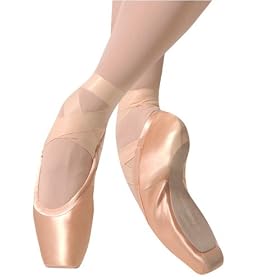 Before Capezios, I spent a year in three different styles of Gaynor Mindens. I never had problems getting over the box before, which is what this shoe is supposed to be helpful for. The Gaynors were pre-formed with plastic shanks. They lasted a long time (unfortunately) and were pretty shoes, but definitely not for me. I know lots of people like them, but none of the professionals at our ballet company wore them - not even the dancer/teacher who wanted us to get them. Luckily, my main instructor that year, Miss Deborah who danced many years at several ballet companies, was excellent. The training is more important than the shoe... though a good shoe makes it easier.
 I had a professional fitting out-of-town (at a place people raved about) before this. The man who fitted me, Mark, had a wife who was a professional dancer. He himself had spent many years studying the anatomy of the foot and figuring out how to prevent dancers from having severe foot problems and surgeries as their careers progressed. He put me in Russian Pointe shoes with toe spacers and gellows toe pads. After dancing in them for a while, the dancer/teacher (mentioned above) disliked how they looked on my feet. She didn't like the high vamp and that my feet looked big in them. (Btw, my feet ARE bigger - I wear an 8 1/2 street shoe.) I agree that the Russian Pointes were not THAT pretty. My feet felt great though, and I became very strong on pointe during this time because my feet didn't ache, blister and bleed as much as everyone else's. :) I liked these and thought they were comfortable; but I have not gone back to them. (Did I mention I really like my Capezios right now?)
 My first pairs of pointe shoes (purchased right after I turned 11) were Sanshas. They were not really the best shoe for me. For some weird reason, the ballet company had a lot of brand new pointe shoes (originally purchased for the professional dancers) left over after the season. They suggested that the girls graduating to pointe try to find a pair in our size and use those. My mom didn't love this idea since this was my first time on pointe (and looking back, it was not really how my ballet school usually did things this important), but we did buy a couple pairs of size 7 Sanshas. They ended up looking pretty and made my arch (which is lower) look good. Even though my mom trusts my teachers to train me and doesn't offer advice, she used to dance herself and shared stories of what worked for her when breaking in her own shoes. The Sanshas were not really comfortable (but whose first pointe shoes are, anyway?) I ended up outgrowing them before I even really used most of the pairs. That said, my soft slippers of choice are def. Sansha.
And one little p.s.
 I have never tried these, but I am intrigued by the Leo split soles that I recently ran across. I spend some time and effort making sure my shoes are prepared before I ever dance in them. I am so curious how this split sole compares to my regular pointe shoes after I first break the shanks. I should read a product review, find someone who's tried them (no one I know, so far) or maybe try out a pair sometime.
Capezio Glisse Pro
I love my Capezio Glisse Pro pointe shoes. My feet feel great and I love the platform. I've also tried the Capezio Plie, but I went back to the Glisse Pro - those suit me best. I like the regular shank - hard shanks aren't for me. I'm pretty strong at pointe work after three years, but these shoes are easily the best I've tried and my feet look pretty in them. Before wearing a new pair of shoes, I break the shank and use gorilla glue to glue it back and then put a few drops in the toe box.Before Capezios, I spent a year in three different styles of Gaynor Mindens. I never had problems getting over the box before, which is what this shoe is supposed to be helpful for. The Gaynors were pre-formed with plastic shanks. They lasted a long time (unfortunately) and were pretty shoes, but definitely not for me. I know lots of people like them, but none of the professionals at our ballet company wore them - not even the dancer/teacher who wanted us to get them. Luckily, my main instructor that year, Miss Deborah who danced many years at several ballet companies, was excellent. The training is more important than the shoe... though a good shoe makes it easier. I had a professional fitting out-of-town (at a place people raved about) before this. The man who fitted me, Mark, had a wife who was a professional dancer. He himself had spent many years studying the anatomy of the foot and figuring out how to prevent dancers from having severe foot problems and surgeries as their careers progressed. He put me in Russian Pointe shoes with toe spacers and gellows toe pads. After dancing in them for a while, the dancer/teacher (mentioned above) disliked how they looked on my feet. She didn't like the high vamp and that my feet looked big in them. (Btw, my feet ARE bigger - I wear an 8 1/2 street shoe.) I agree that the Russian Pointes were not THAT pretty. My feet felt great though, and I became very strong on pointe during this time because my feet didn't ache, blister and bleed as much as everyone else's. :) I liked these and thought they were comfortable; but I have not gone back to them. (Did I mention I really like my Capezios right now?) My first pairs of pointe shoes (purchased right after I turned 11) were Sanshas. They were not really the best shoe for me. For some weird reason, the ballet company had a lot of brand new pointe shoes (originally purchased for the professional dancers) left over after the season. They suggested that the girls graduating to pointe try to find a pair in our size and use those. My mom didn't love this idea since this was my first time on pointe (and looking back, it was not really how my ballet school usually did things this important), but we did buy a couple pairs of size 7 Sanshas. They ended up looking pretty and made my arch (which is lower) look good. Even though my mom trusts my teachers to train me and doesn't offer advice, she used to dance herself and shared stories of what worked for her when breaking in her own shoes. The Sanshas were not really comfortable (but whose first pointe shoes are, anyway?) I ended up outgrowing them before I even really used most of the pairs. That said, my soft slippers of choice are def. Sansha.And one little p.s.
I have never tried these, but I am intrigued by the Leo split soles that I recently ran across. I spend some time and effort making sure my shoes are prepared before I ever dance in them. I am so curious how this split sole compares to my regular pointe shoes after I first break the shanks. I should read a product review, find someone who's tried them (no one I know, so far) or maybe try out a pair sometime.
Saturday, April 17, 2010
Subscribe to:
Posts (Atom)

